Imagine being less than an hour into a flight from Washington, D.C., to Rome, when your pilot suddenly makes an unexpected U-turn back to Dulles International Airport. That’s exactly what happened recently to passengers aboard United Airlines Flight 126. The reason? A passenger had somehow dropped a laptop down the sidewall of the plane and into the cargo hold.
“We don’t know the status of it, we can’t access it, we can’t see it,” one of the pilots explained to air traffic control. “So, our decision is to return to Dulles and find this laptop before we can continue over the ocean.”
It might seem like an extreme reaction, but it was the right decision. Laptops — and other rechargeable devices including smartphones, tablets, and portable battery packs — are powered by lithium-ion batteries, which, if overcharged, damaged, or poorly manufactured, can go into thermal runaway, an uncontrollable self-heating state that can result in fire or even explosion. According to data from UL Standards & Engagement’s Thermal Runaway Incident Program, thermal runaway incidents on planes actually happen at an average rate of twice per week.
“I’m absolutely concerned planes are at risk,” UPS Airlines Captain Bob Brown told NBC News’ Tom Costello in a recent interview on the dangers of rechargeable batteries on planes. “It absolutely could bring down a plane, if you can’t control that event.”
So how can cabin crew members take control of a thermal runaway event? Depending on the circumstances, there are more options than turning around. In the case of the United flight to Rome, the crew couldn’t locate the laptop and had to land the plane out of an abundance of caution. But for rechargeable devices that show signs of thermal runaway (overheating, swelling, or smoking) and are accessible, flight attendants are trained to handle these situations.
One of the tools crew members on some airlines are trained to use is a battery fire containment product. According to the UK Civil Aviation Authority, an uncontrolled fire on an aircraft can become non-survivable in about 19 minutes on average. However, a battery fire containment product certified to our standard, UL 5800, could contain a burning device for up to six hours, allowing the plane to reach an airport.
If you’ve never heard of this issue, let alone battery fire containment products, here’s what you should know:

most commonly asked
What is a battery fire containment product?
A battery fire containment product is typically an insulated bag or box designed to contain and mitigate the effects of smoke and fire from a portable electronic device entering thermal runaway. In the event of a thermal runaway event, a device can be placed into a containment product, which will help to contain any visible smoke, shrapnel, sparks, or flames emitting from the device.
How do battery fire containment products work?
A battery fire containment product acts as a secure enclosure that isolates the fire and contains smoke and debris from a device entering thermal runaway. It typically features a combination of fire-resistant materials, insulation materials and inner liners, and secure closures, which all work together to help manage heat and prevent the escape of flames, smoke, or shrapnel. By enclosing the fire risk and smoke, containment products offer more time to get the plane safely on the ground and help ensure the safety of passengers and crew.
Why do safety standards matter for battery fire containment products?
In order to conform to our standard, UL 5800, a battery fire containment product must undergo rigorous testing with actual lithium-ion cells driven into thermal runaway, to ensure it can contain and mitigate flames, shrapnel, and visible smoke. During these tests, all cells are allowed to burn for up to six hours, if necessary. Products that contain all flames, shrapnel, and visible smoke are classified as “Performance Level 1,” and products that contain all flames and shrapnel, but limit smoke to no more than 5 cubic meters are classified as “Performance Level 2.” If a containment product successfully passes these tests, it receives certification to UL 5800 (see Manufacturer B in these FAA testing videos). Products that are not certified to UL 5800 cannot provide the same level of assurance.
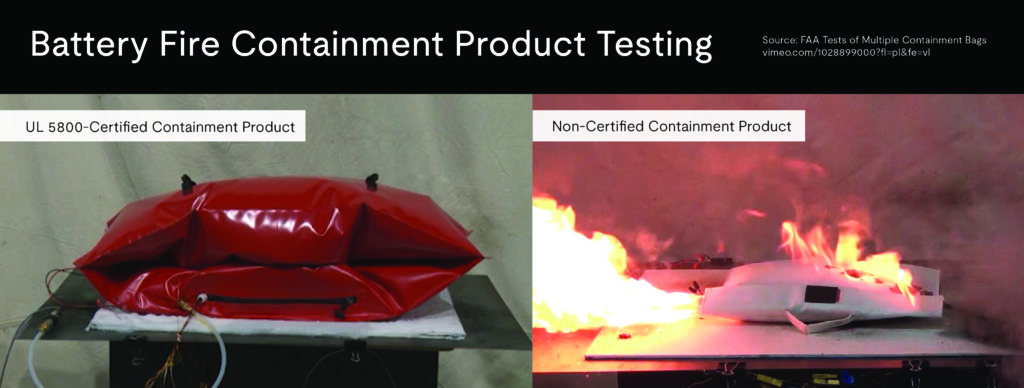
Why aren’t battery fire containment products required on all aircraft?
In the long term, we would like to see a certified fire containment device on board every aircraft. Many containment products came on the market before a safety standard was available. At the request of the airlines, ULSE worked quickly to publish UL 5800 in December 2020, and manufacturers are working to develop products that can meet its requirements. However, only a handful of battery fire containment products have received certification to UL 5800 thus far.
And while we do want a certified containment product on every aircraft, we would also like to see a future in which containment products are rarely, if ever, deployed. And that begins with passenger education.
How can passengers contribute to safer skies?
Whether on the ground or in the sky, the first step in fire safety is always prevention. Passengers need to be aware of the risk and act accordingly by always keeping rechargeable devices in arm’s reach, never packing devices in checked luggage, and by knowing when to notify flight attendants at the first signs of thermal runaway. According to ULSE data, half (50%) of Americans admit to knowing nothing about these batteries, and almost 2 in 5 (38%) of U.S. passengers admit to putting rechargeable devices in their checked luggage, where they can’t be accessed during flight.
Containment devices are a helpful tool in battery safety on board, but they are just one component of a layered safety approach, and not the only solution. If customers are informed on the dangers of lithium-ion battery fires and best practices for avoiding them, it will significantly reduce the need for flight attendants to deploy them in the air.