Throughout your home, there are undoubtedly a number of products that use button and coin cell batteries — the key fob for your car, the watch on your wrist, the small flashlight in your kitchen junk drawer, the hearing aid in your ear, the digital thermometer in your medicine cabinet…
These small batteries have become a critical component of everyday life, powering many of the small electronics we rely on every day. However, they carry a significant risk.
Button batteries and coin cell batteries can burn the lining of the stomach when swallowed, and this risk is particularly hazardous for babies and toddlers who are in the habit of putting objects in their mouths.
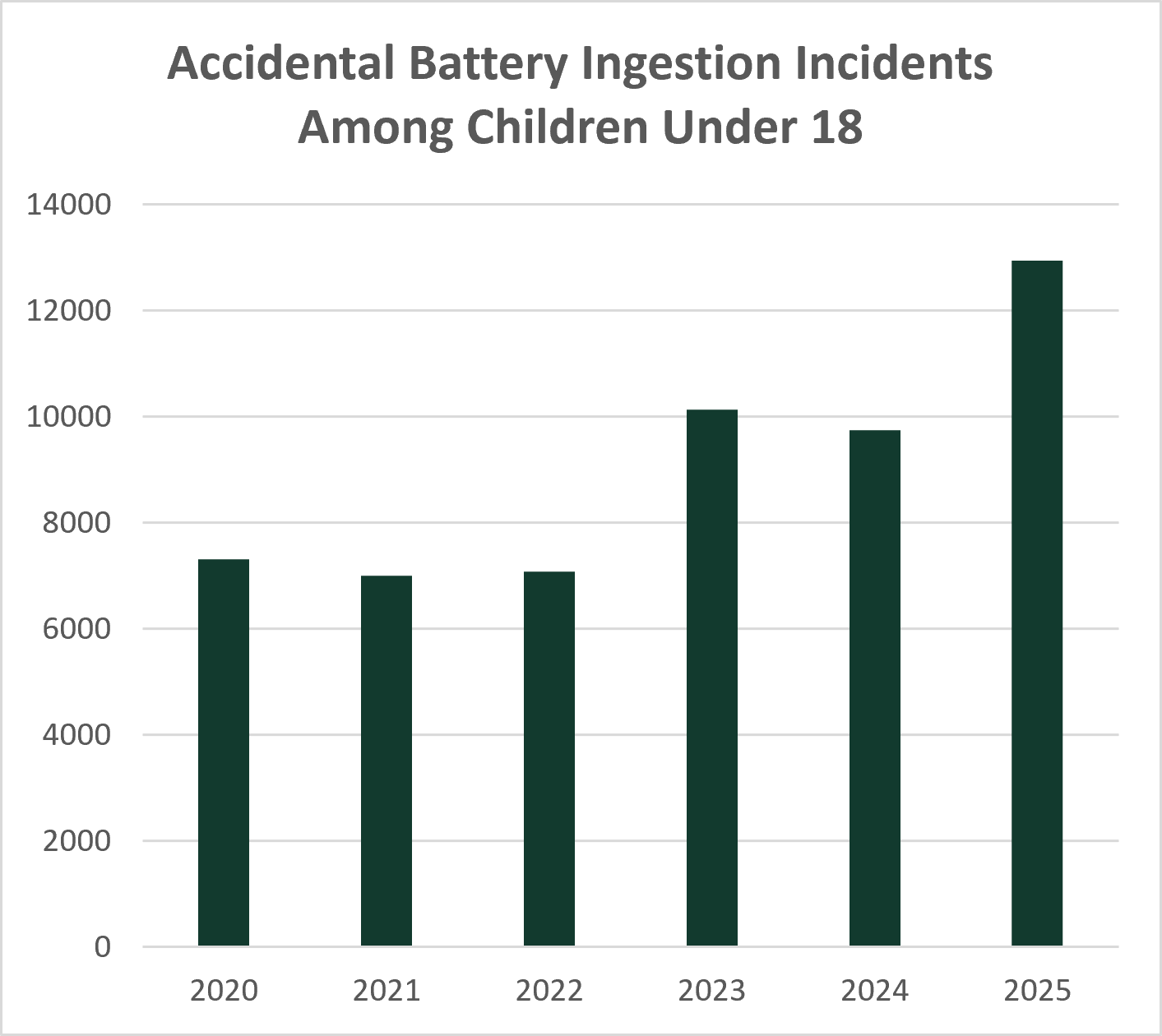
Source: U.S. Consumer Product Safety Commission. (2026). National Electronic Injury Surveillance System (NEISS).
From 2010 to 2019, there were more than 70,000 battery-related emergency room visits among children under 18, averaging to about 3,289 incidents per year. And nearly all (85%) were related to button or coin cell batteries.
From 2020 to 2025, there were more than 54,000 emergency room visits involving accidental battery ingestion for this age group, averaging to about 9,040 incidents per year.
It’s an alarming trend, but it’s one that has driven action. Through ongoing collaboration with industry experts and stakeholders, UL Standards & Engagement has established requirements in UL 4200A, the Standard for Products Incorporating Button Batteries or Coin Cell Batteries, which help to ensure button or coin cell batteries are securely fastened inside of electronics, where children cannot access them.
How UL 4200A Helps Protect Children
Our standard, UL 4200A, requires manufacturers to secure button and coin cell batteries in products with enclosures that help to prevent children from accessing them. The standard permits two methods – the first requires either the use of a tool such as a screwdriver or coin to open the battery compartment, and the second permits the application of two independent and simultaneous movements to open by hand.
In order to conform to the standard, a product must have compartments that remain closed after tests that simulate normal use and abuse, such as a drop onto a hardwood surface or pressure under a crushing force. The standard also requires warnings on the product packaging, instructions, and manuals and on the product itself, if space allows.
In other words, when your car key gets dropped, or the digital thermometer gets stepped on, UL 4200A helps to ensure the batteries stay secure inside, where children cannot access them.
The standard also requires warnings on the product packaging, instructions, and manuals and on the product itself, if space allows.
Ongoing Action
In September of 2023, following the passage of Reese’s Law, the US Consumer Product Safety Commission made UL 4200A mandatory for consumer products that contain button batteries and coin cell batteries. Products manufactured prior to 2023, however, are still in many American homes, and may be for some time. Although the number of accidental battery ingestion incidents has continued to increase, we do believe the requirements in UL 4200A will have a significant impact in reducing the number of incidents in the years ahead.
For consumers, it’s important to exercise care when handling button and coin cell batteries. After removing batteries from products, be sure to keep them away from children and to dispose of them properly. Consider keeping a dedicated locking box or zippered pouch for holding batteries. Visit the Battery Network to find a drop-off location that you could easily frequent when you have batteries to dispose of.
How You Can Help Make Products Safer
Our standards are developed through a consensus-based process, which integrates scientific and testing expertise with input from our technical committee members and stakeholders. TC members represent a variety of interests, including industry, academia, government, retail and manufacturing. If you are involved in the design, construction, sale, installation or inspection of button/coin cell batteries and products that use them, and you would like to help improve safety in your industry, please take a moment to learn how you can get involved.
If You Think Someone Has Swallowed a Battery
A swallowed battery is a medical emergency. If you think someone has swallowed a battery, call the National Battery Ingestion Hotline at (800) 498-8666 or Poison Control at 1-800-222-1222 right now.