AT A GLANCE
- As autonomous trucks begin operating on public roads, manufacturers must demonstrate that their systems can safely handle real-world conditions and unexpected events.
- Our standard for autonomous vehicles, UL 4600, provides a technology-agnostic framework for building evidence-based safety cases, helping companies validate performance, reduce risk, and build public trust.
Critics and supporters alike have questions and concerns about autonomous trucking: How disruptive will this be to the industry? How beneficial will it be for society? How do autonomous trucks handle unpredictable situations?
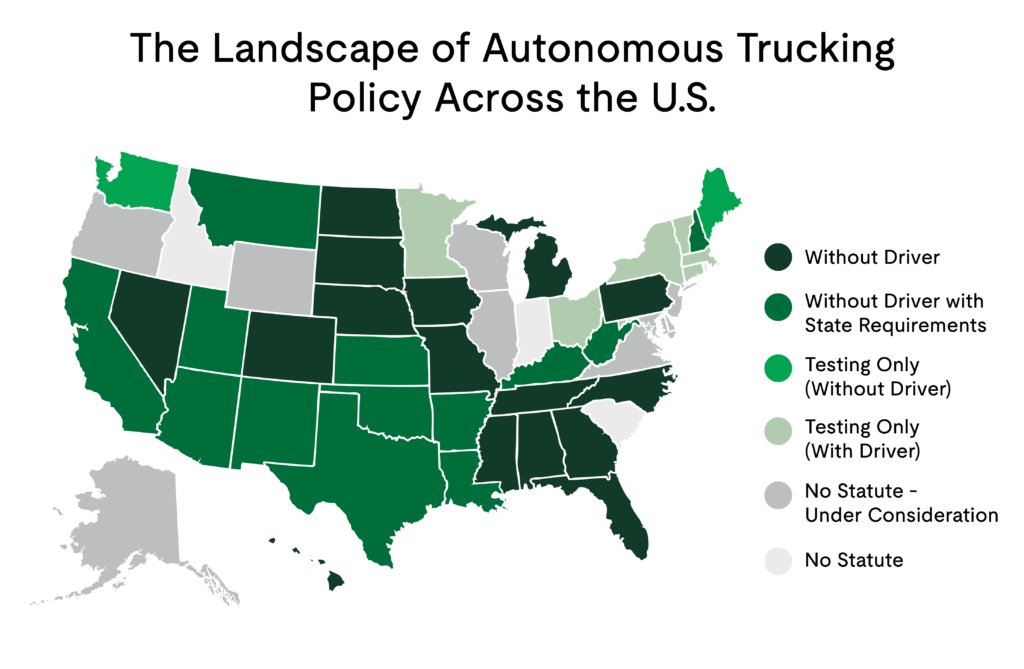
We may not have answers to every single question yet, but one issue we cannot overlook is safety. Autonomous trucks are already sharing the road with drivers in nearly 40 states. Our top priority right now should be to make sure these vehicles are as safe as possible.
A new bill, The BUILD America 250 Act, aims to establish the first federal framework for autonomous commercial trucks operating in interstate commerce. Specifically, the bill would require a performance-based safety standard for commercial vehicles operating in interstate commerce with automatic driving systems. In order to meet the standard, manufacturers would be required to establish a safety case, supported by arguments and evidence, that the vehicle equipped with an automated driving system will provide an equivalent or greater level of safety as a non-ADS equipped vehicle.
How UL 4600 Can Help Manufacturers
Our standard for autonomous vehicles, UL 4600, provides the tools for manufacturers to establish exactly this type of safety case. And in 2023, the standard was updated with revised safety case guidelines to support autonomous trucking.
Through its safety case guidelines, UL 4600 helps make sure autonomous trucking companies can answer important safety questions, such as what happens if a sensor is covered in mud? Are AVs trained to identify hazardous weather conditions and adjust driving and braking accordingly? What happens if a pedestrian enters the roadway unexpectedly? For a fleet-scale autonomous system, a safety case will address thousands of these questions with information on how systems like perception, prediction, braking, steering, and fallback behavior respond; what timing assumptions are used; what test, simulation, or field evidence supports the response; and what residual risk remains.
In doing so, a manufacturer can show that its trucks are acceptably safe for their intended application, environment, and lifecycle.
Where UL 4600 Is Already Working
Autonomous trucking companies are already using UL 4600 to keep their vehicles moving safely. Gatik, which delivers across the U.S. and Canada for companies like Walmart, Kroger, Pepsi, and Tyson, uses UL 4600 as the foundation for its safety case framework:
“UL4600 was developed with the explicit intent to address the unique challenges of safety in driverless operations. Additionally, it’s technology-agnostic, dictating a level of safety that’s not insistent on any specific design approach or specific technology use. It’s one of the reasons that UL4600 serves as the ideal foundation for Gatik’s safety case framework,” the company says.
Guiding the Industry with Expert Input
Nearly 40 voting members currently contribute to the ongoing development of UL 4600 through a ULSE technical committee. Automakers, insurance companies, researchers, consumer advocacy organizations, government agencies, and representatives throughout the supply chain, all come to the table to propose updates, discuss, and vote on any changes to the standard, all in the interest of safety. This balanced format helps ensure consensus on the requirements that will help guide the safe development of autonomous trucking — giving the industry a common foundation and providing a structured, technology-agnostic framework that helps manufacturers build safety cases that stand up to scrutiny.
As autonomous trucking scales, the companies that lead will be those that can demonstrate safety with clarity and evidence. By grounding system design, testing, and validation in a shared language of safety, UL 4600 enables autonomous trucking companies to move faster with confidence, reduce operational risk, and earn the trust of the partners and communities they serve.
We may not have the answers to every question about autonomous trucking yet, but UL 4600 can help make sure manufacturers are answering those that are most important — questions about safety. And in a rapidly, evolving market, it’s not just a standard but a competitive advantage for every organization committed to deploying autonomous trucks responsibly and at scale.