AT A GLANCE
- Autonomous vehicles are advancing quickly, with driverless deployments already underway, making safety assurance a critical priority as adoption accelerates.
- ULSE standards such as UL 4600 and UL 4740 help address AV safety, providing guidance for evaluating autonomous systems and key technologies like lidar under real‑world conditions.
- Standards‑based safety frameworks support public trust, helping manufacturers demonstrate responsible deployment while reducing risk on public roads.
Self-driving vehicles are no longer just a possibility. Instead, they are an inevitability. But their adoption raises many questions. And the most important is how to ensure the safety of this revolution in transportation.
Fully driverless robotaxis are currently operating in approximately 10 cities, including Phoenix, San Francisco, Los Angeles, Austin, Atlanta, and Miami, with companies announcing plans to expand into 20 more in the near future. And 230,000 autonomous vehicles are expected on U.S. roads by 2034.
As more of these driverless vehicles share the road with motorists each day, the need for safety only increases, and USLE’s safety standard, UL 4600, Evaluation of Autonomous Products, helps promote the safety of this technology and preserve access for motorists.
Understanding Autonomous Vehicles
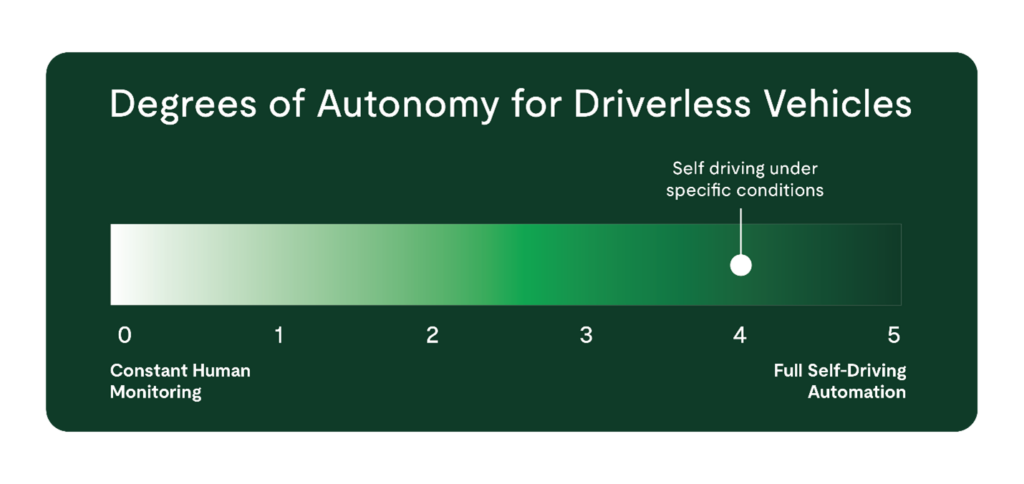
Self-driving cars, or autonomous vehicles, are cars, trucks, or similar vehicles that can operate without human intervention. There are varying degrees of autonomy for these vehicles, from Level 0 (with constant human monitoring), to Level 5, (with full self-driving automation). Today, most self-driving vehicles are being tested to operate at Level 4, meaning they can drive themselves, but only under specific conditions that take into account road type, geography, weather, and traffic conditions.
How Driverless Cars Work
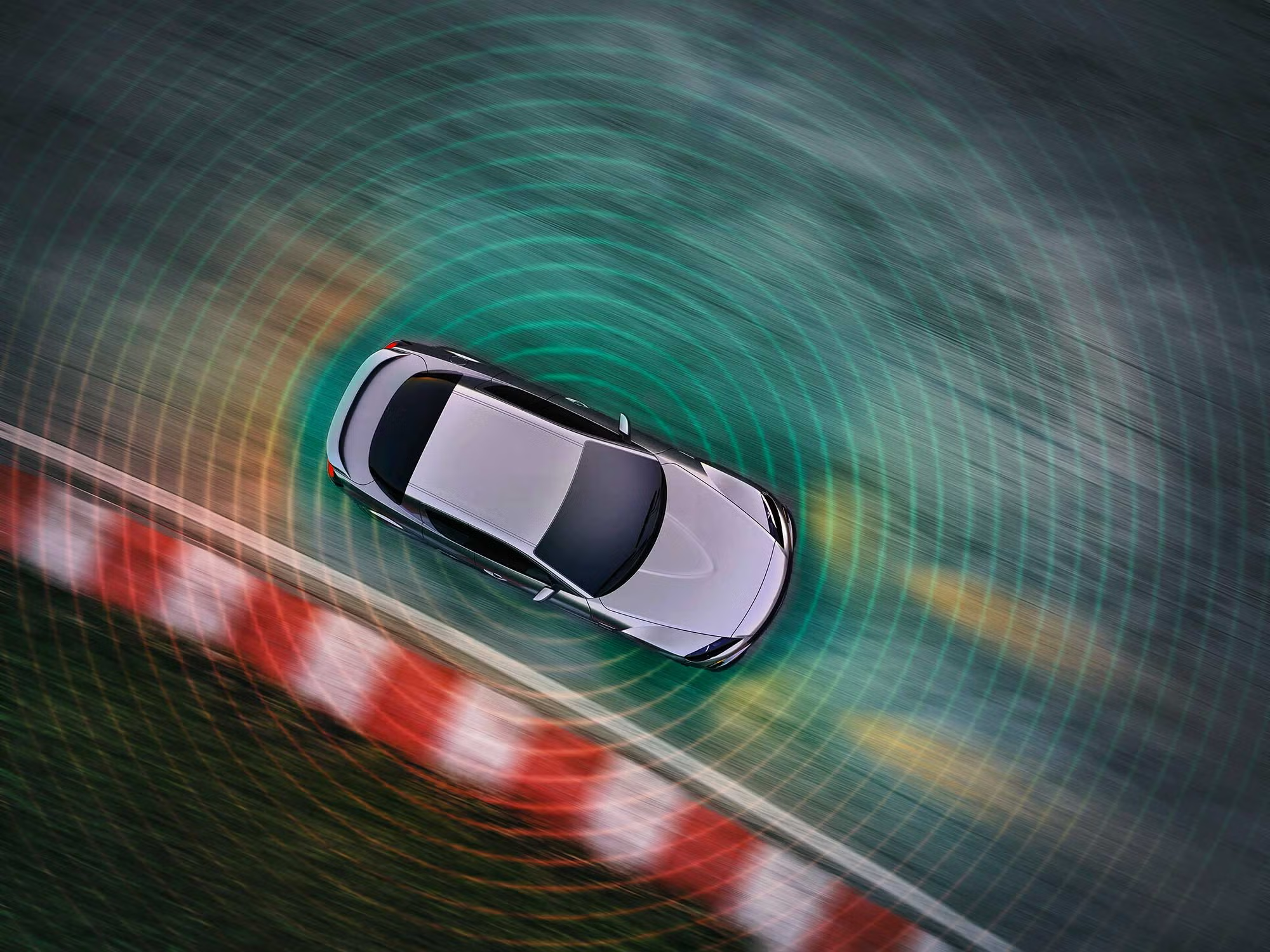
Autonomous vehicles rely on advanced perception systems (comprised of multiple sensors, including cameras, radar, and laser scanner technology), which allow them to understand their surroundings.
Lidar (light detection and ranging) mapping sensors are critical for helping autonomous vehicles navigate, emitting laser pulses that create detailed three-dimensional maps of the environment around the vehicle. These maps let autonomous systems detect obstacles, measure distance, and identify safe driving paths in real time.
Because accurate knowledge of surroundings is essential for safe driving, lidar technology has become one of the main sensing tools in autonomous vehicles. Our standard, UL 4740, Standard for Safety for Lidar and Lidar Systems Used in Vehicles, evaluates the ability of lidar systems to withstand operating conditions, helping ensure optimal protection of components even in harsh conditions, such as vehicle damage or dirt exposure.
Why Autonomous Vehicle Safety Matters
AV safety matters because there is a very high risk of injury or death to drivers, passengers, and pedestrians, especially in the early stages of this technology, and if something does go wrong, it could potentially impede future innovation.
Critics have always been quick to claim that innovations in transportation (from cars to trains to planes) aren’t worth the risk, and as autonomous vehicles currently work to win their acceptance, safety must be the paramount concern. Through the development of standards like UL 4600, we’re working to help make autonomous vehicles safe, rather than allowing the technology to be pushed aside.
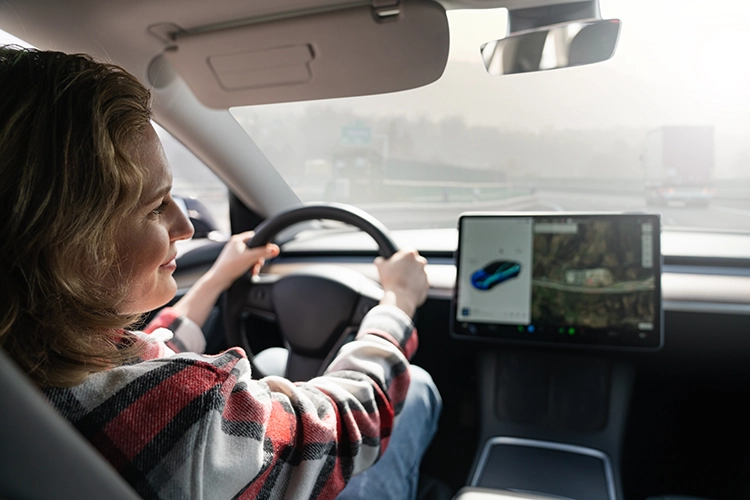
Are Self-Driving Cars Safe?
Self-driving cars, when built to safety standards and when used as intended, are typically safer than human-operated cars.
While there is no shortage of headlines about driverless vehicle mishaps, underscoring the fact that computers are capable of making errors, company reports and academic studies both show that autonomous vehicles have fewer accidents that cause serious injuries, when compared with human drivers.
In 2013, the University of Michigan Transportation Research Institute found that, although self-driving vehicles were involved in more crashes and had a higher rate of injury per crash, they were not responsible for any of the crashes studied, and injuries were less severe than with conventional vehicles.
In 2025, Waymo reported 92% fewer serious injury crashes, 82% fewer injury-causing crashes, and 92% fewer pedestrian crashes with injuries, compared to human drivers.
There were nearly 41,000 fatal motor vehicle crashes across the nation in 2023, but as autonomous technology evolves, it may be able to prevent many human-caused accidents, particularly those involving alcohol, drugs, fatigue, and lack of attention. The Rand Corporation says autonomous vehicles could prevent 600,000 fatalities over 35 years.
Ultimately, determining whether autonomous cars and trucks are safe requires evaluating how systems respond to complex road conditions and unexpected events. And safety standards can help.
How Standards Help Keep AVs Safer
UL 4600, the Standard for Evaluation of Autonomous Products, helps evaluate how AVs perform in situations that differ from the typical flow of traffic. The standard requires manufacturers to perform rigorous hazard analysis and risk evaluation in the development of a safety case that evaluates the entire system, including sensors, software, hardware, and operating conditions, to demonstrate that risks are properly managed.
Compared to other standards, UL 4600 is unique in that it provides process framework that companies can use in developing a safety case, rather than required criteria for testing. Because of this difference, companies may use 4600 as a guidance document, rather than a certification program. For example, Waymo references UL 4600 in its safety case document, “Building a Credible Case for Safety: Waymo’s Approach for the Determination of Absence of Unreasonable Risk,” as does Aurora Innovation in its “Safety Case 101.”
As technology takes the wheel, standards like UL 4600 will play a larger role in shaping how these systems are designed, tested, and deployed. The goal is simple: ensuring that safety is driving the future of autonomous mobility.