En un coup d'œil
- Most EV batteries retain 70–80% capacity at end of vehicle life, enabling second‑life uses like energy storage.
- Consumers lack confidence in recycling and reuse, despite growing infrastructure and future capacity.
- ULSE standards support safe repurposing, recycling, and circular battery design to help reduce environmental risk.
Les ventes de véhicules électriques continuent de croître considérablement depuis leur essor il y a un peu plus d'une décennie, avec 141 % des Américains maintenant posséder un véhicule électrique, un véhicule électrique hybride rechargeable ou un véhicule électrique hybride.
des adultes américains n'ont pas confiance dans le recyclage ou la réutilisation responsable des batteries de véhicules électriques
Cette croissance des ventes soulève également une question importante : qu'advient-il des batteries lithium-ion économes en énergie et en coûts qui alimentent ces véhicules lorsqu'elles commencent à s'user ?
Selon un nouveau étude des normes et de l'engagement d'UL, les consommateurs ne sont pas tout à fait sûrs.
Dans cet article, nous examinons de près certains des résultats de l'enquête et abordons certaines des questions, préoccupations et lacunes en matière de connaissances concernant le cycle de vie des batteries de véhicules électriques.
Pratiques de fin de vie pour les batteries de véhicules électriques
En ce qui concerne l'élimination des batteries des véhicules électriques (VE) et des véhicules hybrides rechargeables (VHR), les adultes américains expriment de réelles inquiétudes quant aux risques environnementaux, sanitaires et d'incendie qui y sont associés, et nombreux sont ceux qui ne sont pas convaincus que ces sources d'énergie soient correctement recyclées ou réutilisées. Seuls 38 % estiment que les batteries sont recyclées pour en récupérer les matériaux précieux, et 44 % ne sont pas convaincus qu'elles soient recyclées ou réutilisées de manière responsable. De plus, seuls 15 % pensent que les batteries sont réutilisées ou recyclées pour le stockage d'énergie domestique ou sur le réseau.
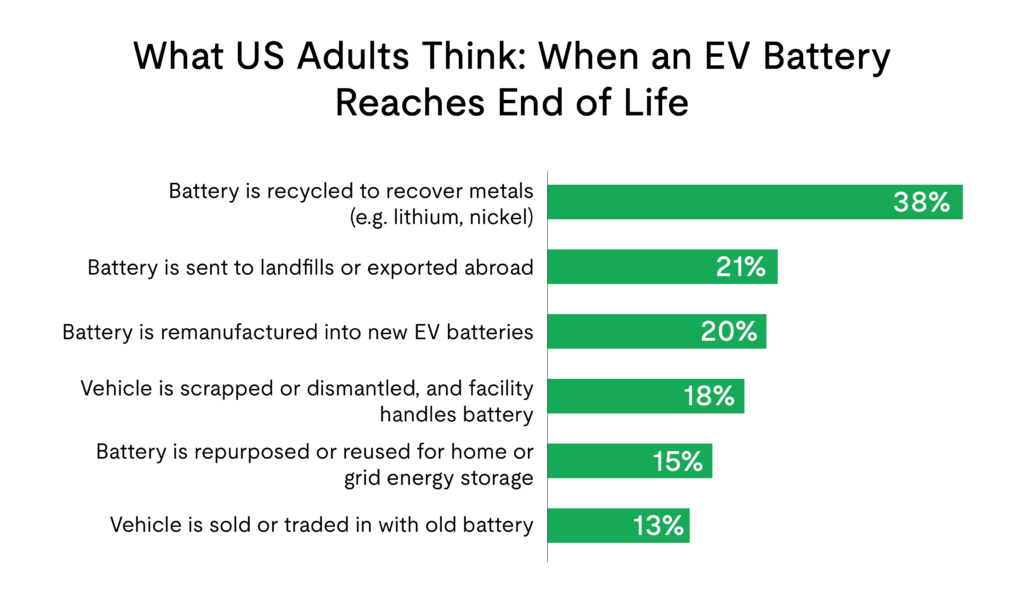
En réalité, la plupart des VE grand public de première génération sont encore utilisés, la première vague majeure de véritables retours de batteries de VE en fin de vie étant attendue au milieu des années 2030. Et selon L'Agence Internationale de l'Énergie, Les efforts actuels en matière de recyclage et de reconditionnement permettent à l'industrie de se préparer à l'important volume de batteries qui seront mises hors service à ce moment-là. Même lorsque ces batteries ne sont plus aptes à alimenter un véhicule, elles conservent généralement environ 70 à 80 % de leur capacité énergétique, ce qui les rend intéressantes pour des applications de seconde vie.
Durée de vie du service de batterie de VE
Selon la dernière enquête ULSE sur les véhicules électriques, 32% des adultes américains pensent que les batteries des véhicules électriques ont généralement une durée de vie de 5 à 8 ans. En réalité, la plupart des batteries de véhicules électriques sont couvertes par une garantie de 8 à 10 ans (soit environ 160 000 km), et de nombreux blocs-batteries conservent 70 à 80 % de leur capacité même après environ 12–15 ans. Bien que cet état de santé faible soit inférieur au seuil de performance automobile, ces batteries restent souvent fonctionnelles et utilisables bien après avoir atteint ce point.
Réutilisation des batteries de VE
Les entreprises qui réutilisent sont à la pointe de solutions innovantes. Certaines reconvertissent des batteries de véhicules électriques pour alimenter des systèmes de stockage d'énergie qui soutiennent les réseaux électriques et les projets d'énergies renouvelables, tels que l'éolien et le solaire. Un fournisseur a récemment achevé un système BESS au Texas avec environ 500 packs de batteries de véhicules électriques en fin de vie, et un autre en Californie avec 1 300 anciennes batteries de véhicules électriques. Dans bon nombre de ces installations, des normes telles que UL 9540 pour les systèmes et équipements de stockage d'énergie contribuer à la gestion des risques liés à la sécurité. Parmi les personnes interrogées qui ne possèdent pas de véhicule électrique, 49% ont déclaré que le fait que ces batteries puissent être réutilisées pour le stockage d'énergie avait influencé positivement leur perception de l'achat de ce type de véhicule.
Recyclage des batteries de VE
Les batteries de véhicules électriques peuvent être démontées pour réutiliser des composants tels que les modules qui maintiennent les cellules, le système de refroidissement et l'ordinateur embarqué. De nombreux matériaux précieux des batteries, tels que le lithium, le nickel, le cobalt et le cuivre, peuvent être recyclés à partir des batteries de véhicules électriques. Même lorsque les batteries sont réutilisées, elles doivent finalement être recyclées pour récupérer ces métaux critiques en fin de vie. Les matériaux peuvent être récupérés par des procédés hydrométallurgiques/pyrométallurgiques ou par des méthodes de recyclage direct émergentes, réapprovisionnant ainsi la fabrication de cellules en matériaux de qualité batterie.
Deux normes ULSE, UL 3601, Mesure et rapport sur la circularité des batteries Li-ion et autres batteries secondaireset UL 1974, Évaluation pour le réemploi ou la remanufacturation des batteries, peut contribuer à garantir que les batteries sont conçues pour être réutilisées ou recyclées, et que les installations sont équipées pour les traiter avec les bons procédés.
Lorsque la vague des retours de batteries de véhicules électriques commencera au milieu des années 2030, Capacité de recyclage des États-Unis devrait en fait dépasser les matières premières de recyclage de batteries disponibles.
Impact environnemental
Les analyses de cycle de vie montrent de manière constante que les véhicules électriques ont des émissions de gaz à effet de serre inférieures à celles des véhicules à moteur à combustion interne, même en tenant compte de la production de la batterie. En 2014, les émissions totales de gaz à effet de serre sur le cycle de vie des véhicules électriques étaient de 5,41 TP3T en baisse que celles des véhicules à moteur à combustion interne (ICE), et les émissions de GES liées au cycle du carburant des véhicules électriques (VE) étaient inférieures de 15,11 % à celles des ICE. Cependant, si les batteries en fin de vie ne sont pas gérées correctement, elles peuvent poser des problèmes environnementaux importants. La mise en décharge des batteries peut entraîner le rejet de substances dangereuses qui contaminent le sol et les eaux souterraines, notamment des solvants organiques provenant des électrolytes et des métaux issus des matériaux cathodiques. Bien que les risques spécifiques varient en fonction de la composition chimique des batteries, leur réutilisation et leur recyclage réduisent considérablement leur impact sur l'environnement.
Méthodologie
Les données de l'enquête proviennent de la vague de décembre 2025 de la série ULSE Consumer Tracker, un projet longitudinal basé sur des enquêtes comprenant plusieurs piliers thématiques examinant la sensibilisation, les attitudes et les comportements des consommateurs américains liés aux domaines de risque potentiels. Ces enquêtes sont conçues pour être représentatives au niveau national.
Cette vague d'enquête a été réalisée auprès de 2 218 adultes américains, et les résultats sont statistiquement significatifs avec un niveau de confiance de 95 %, la marge d'erreur d'échantillonnage étant de ±2,21 %.