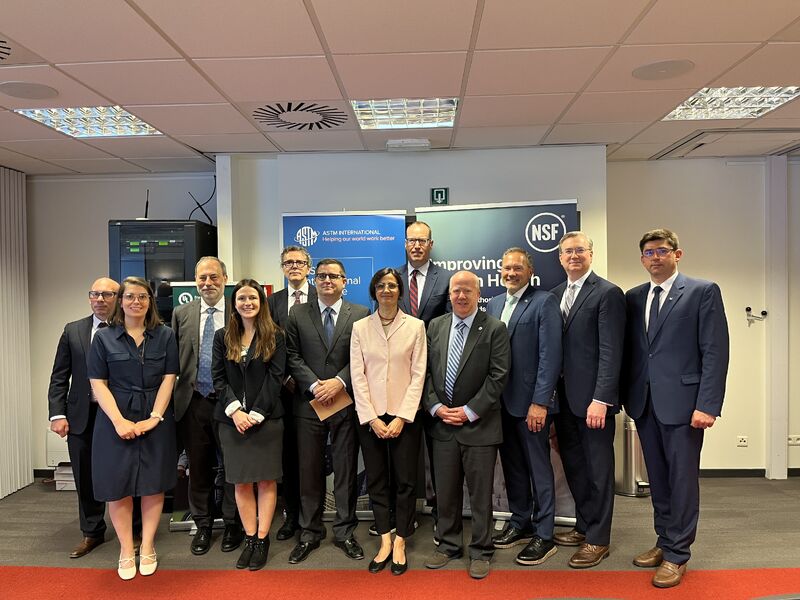
On May 27, 2026, UL Standards & Engagement, together with representatives from ASTM International and the United States National Science Foundation, and in partnership with the U.S. Mission to the European Union, hosted the panel session, “Building Bridges with Global U.S. Standards Organizations for Safe Transatlantic Trade.” The session highlighted the critical role U.S.-domiciled standards bodies play in supporting safe, efficient, and innovation-driven trade between the United States and Europe.
ULSE used this platform to underscore its global leadership in battery safety standards, spotlight ongoing collaboration with European partners, and reaffirm the importance of the World Trade Organization’s Technical Barriers to Trade principles in advancing international alignment.
Opening remarks presented by the U.S. Mission to the EU and DG-GROW both noted that deeper cooperation between standards organizations is essential to strengthening the global safety ecosystem and establishing more nimble approaches to address safety challenges in an era of unprecedented innovation.
The roundtable was moderated by ASTM International CEO Andrew G. Kireta. Each participating organization highlighted its most impactful standards within the EU:
- ASTM International discussed its drone standards and its role in supporting emerging technology.
- NSF discussed its work on water safety standards.
- ULSE discussed its leadership in standards for lithium-ion batteries and micromobility.
ULSE and EN Standards Act Complementary Across the Micromobility Industry
ULSE presented a case study to the EU stakeholders reflecting on UL 2271, the Standard for Batteries for Use in Light Electric Vehiclesy UL 2849, the Standard for Electrical Systems for E-bikes, as well as the European complements of these standards, EN 50604, Secondary Lithium Batteries for Light Electric Vehicle Applications, and EN 15194, Electrically Power Assisted Cycles (EPACs), respectively. These standards are already adopted in regulatory frameworks, such as in New South Wales, Australia, where comprehensive policy covers the full safety of e-bikes and batteries. Their adoption demonstrates how EN and ULSE standards offer complementary benefits that create a stronger safety framework.
UL 2271 and EN 50604 further exemplify the EN and ULSE cooperation through the International Electrotechnical Commission. Both standards are currently being harmonized through IEC Joint Working Group 84, through drafting of IEC 63623-1, Secondary Lithium Batteries for Light EV (Electric Vehicle) Applications – Part 1. This effort reflects proactive cooperation, trust building, and the value of leveraging established tools, processes and content to support global safety objectives.
The Future of ULSE Collaboration in Europe
ULSE will continue to fortify facilitate safety conversations and drive trust with Europe and European stakeholders as a convening organization. ULSE technical committees include 4300 members globally from over 60 countries, including many in Europe. Our process adheres to the WTO Technical Barriers to Trade principles and our standards can complement current IEC/ISO structures when the need arises. When ULSE and EN standards build upon one other, rather than compete, they create a more agile model for global safety governance, one capable of supporting and responding to an era of unprecedented innovation.